
Watch excerpts "from the patio"
Enjoy these excerpts from Yellow Barn Patio Noise.
Seth Knopp and Osvaldo Golijov:
"so far, but yet so close"
Osvaldo Golijov's Tenebrae and James MacMillan's Angel
Watch the related performance
Osvaldo Golijov:
Creating a family of ancestors for each piece
Seth Knopp and Tony Arnold:
Homesickness and interpreting a composer's sense of place
Shostakovich's Seven Romances on Poems of Alexander Blok
Watch the related performance
Seth Knopp and Lucy Shelton:
Music making an argument for its own transcendentalism
John Cage's Solo for Voice 43
Watch the related performance

Lucy Shelton:
Deciphering and performance John Cage's Solo for Voice 22
Watch the related performance
Lizzie Burns and Lucy Fitz Gibbon:
Interpreting intimacy in a time of distance; Action and memory in Joyce and Goethe; Shedding light on gender relations
Amy Beth Kirsten's yes I said yes I will Yes.
Watch the related performance
Seth Knopp and dancer/choreographer Daniel McCusker:
How do we talk to an audience in a way that redefines meaning?
Daniel McCusker:
Interpreting Merce Cunningham dances from the time of John Cage
Travis Laplante, with Seth Knopp and Bonnie Hampton:
Composing and interpreting The Obvious Place, improvisation and the meaning of performance
Watch the related performance
Natasha Brofsky, John Myerscough, Laurence Lesser, and Aaron Wolff:
The experience of masks on, and masks off, for performers and listeners
The complete suites for solo cello by J.S. Bach
Watch the related performance
Bonnie Hampton, Gabriel Martins, and Aaron Wolff:
The character of the Bach Cello Suites during this time
Watch the related performance
John Myerscough, Lisa Kang, Michael Katz, Michael Kannen, and Laurence Lesser:
The Bach Cello Suites: Which movement and why?
Watch the related performance
Seth Knopp:
Music is meant for everybody: The music - interpreter - listener continuum
Bonnie Hampton:
Kirchner's Piano Trio and the journey of exploring and performing a new piece of music
Eduardo Leandro:
Performing Lei Liang's Trans, integrating sounds from nature, and with an audience after months of isololation
Watch the related performance
Seth Knopp and Gilbert Kalish:
Hearing Beethoven in Ives's "Concord" Sonata
Watch the related performance
Stephen Coxe and Catherine Stephan:
Using Beethoven's autograph sketches and manuscripts for "Entstehung Heiliger Dankgesang" and an art installation
Alice Ivy-Pemberton, Emma Frucht, Roger Tapping, and Coleman Itzkoff:
Performing Beethoven's "Heiliger Dankgesang" with Stephen Coxe's "Entstehung Heiliger Dankgesang"
Watch the related performance
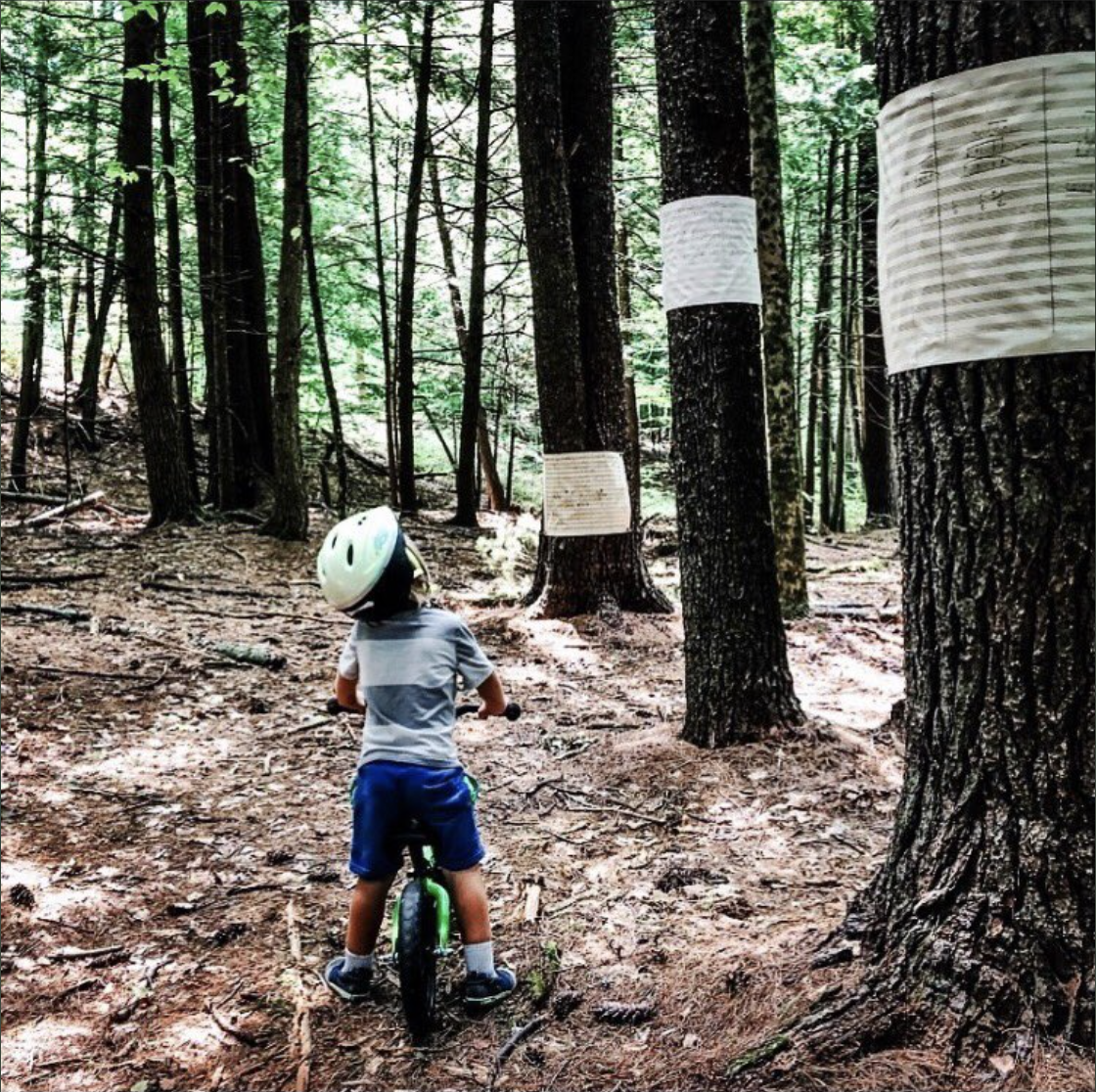
Testimonials for Beethoven Walks
In June 2020, Yellow Barn opened the first two Beethoven Walks trails in Putney, Vermont. Below is a collection of comments that we have received from visitors. Learn more about how to take a Beethoven Walks trail, and afterwards send us your thoughts and photos.
Be sure to take the Hannum Trail before it closes on September 8th!
I just got back from my walk—what an extraordinary experience! It was so magical to be surrounded by the sketches—especially at the listening places, I loved how all of them were angled towards the sitting benches so they seemed to be gazing at you while you looked back. I took your advice and listened without headphones, which made for a great conversation between the recordings and the varying speeds of wind. Each track and spot was really its own gem—I loved that the Mass was elevated and looking down, while the orchestral introduction of the Emperor movement seemed to be part of the ascending landscape, and of course, the uprooted tree at the Heiliger spot was jaw-dropping. By the end the sketches felt like friends—I was sad to exit the forest! I imagine it will be so touching for musicians and non-musicians alike. Also, while in the forest I think I forgot about the pandemic for the first time since it started...which is really saying something.
I did the Hannum trail Beethoven Walk today. What an awesome experience! I don't know where to begin—I'll never hear that music the same way again, and I've never experienced the forest and its noises, silence, and movement in that way before.
I went on the Hannum Beethoven Walk a few weeks ago and OH it is such a beautiful, beautiful thing you’ve made, thank you thank you thank you! For those of us who can only handle so much screen-time, it left our hearts soaring with the same feeling that a live performance brings—the adventure of not knowing what’s around the corner, of giving over to an experience. The way the forest sounds mingled with Beethoven added a kaleidoscope of new shades of feeling and meaning—and left me thinking, how have I never brought Beethoven into the sun—dappled, thrush-laden summer woods before?!? It didn’t feel like a stand-in artistic experience, it felt like THIS is how to listen to Beethoven! Period! And to have his manuscripts painting the path like that...it was magic—pure, loving magic!
The walk is a masterpiece. The cathedral of the pines is a holy place. The wandering, swirling rivulet below the bench is a place of peace. We can list many more such places along the way, each a masterpiece of nature and nurture. We hope, aside from all the complexity one finds upon leaving the woods, and aside from the fleeing nature of this installation and of life, that you feel great pride in what is.
I'm writing to you having just done the beautiful Hannum hiking trail. I was drawn to it by the Yellow Barn app, and I must tell you I absolutely loved it. I've been coming to Putney for many years in the summers but I'd never known about this trail, so I'm very happy to have found it, and I intend to return often! As a music lover, long acquainted with the stories of Beethoven dreaming up his sublime ideas while walking through his woods, I was genuinely moved and delighted to experience this amazingly imaginative and artistic illustration of his process - it's truly inspiring and it was clearly done with such loving care.
I had never hiked that part of the Hannum-O'Connor trail before and had no idea how well-designed and beautiful it is—not in the sense of dramatic views, but rather a window into a quiet Vermont woodland, complete with ferned glades, majestic hemlock groves, trickling streams, and rocky outcrops. And then the Music—some of Beethoven's most moving and sublime compositions beamed right to my cellphone as we strolled the winding path. Ecstasy! The many excerpts from his own drafts and scores decorating the trees along the trail, while not very legible to the novice, give a visual suggestion of the master's energetic genius. It's a wonderful undertaking. Don't miss it!!
We stumbled upon the Beethoven Walk section of the Trail and felt like we fell down the rabbit hole!Amazing, inspiring…
Leon Fleisher (1928-2020)
Today is the first day without our dear Leon Fleisher amongst us. We are all so fortunate to have lived during his time, to have heard the truth he spoke through his playing, and to have witnessed the courage with which he fought to speak it.
—Seth Knopp
On July 23, 2017, Yellow Barn hosted an 89th birthday gala and party for Leon. For the first half of the program, Julian Fleisher joined his father in sharing stories and music from Leon's extraordinary life with music. We share those moments now, with joy and unending gratitude.
Odetta opens concert of Bach's cello suites
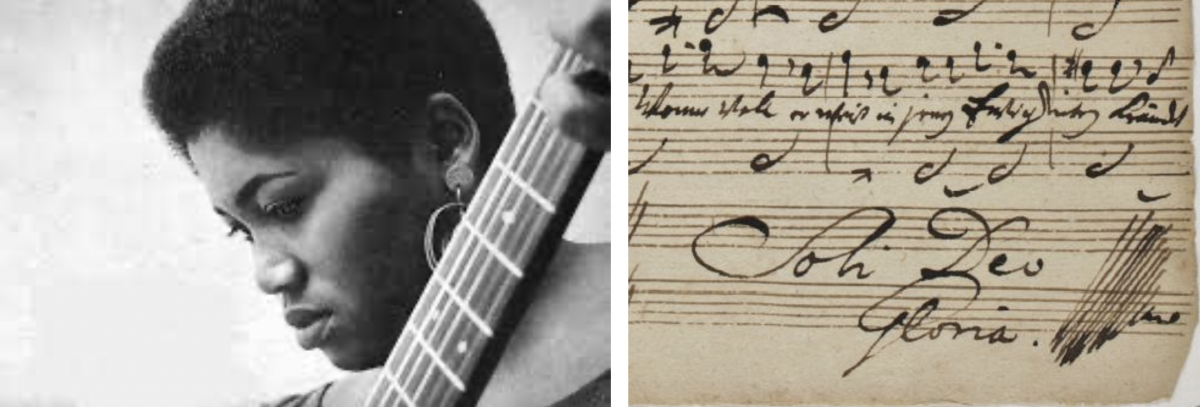
Odetta, with a detail of one of J.S. Bach's autograph manuscripts signed "Soli Deo Gloria" ("To the Glory of God Alone"), a dedication that the composer added to every piece of sacred music and many secular pieces as well.
On July 18, 2020, a recording of Odetta performing the spiritual "Glory, Glory" opened a concert of Bach Cello Suites at Yellow Barn. Following the concert, alumna cellist Annie Jacobs-Perkins wrote the following biographical note for Odetta:
In his letter to America penned days before his death, activist and Representative John Lewis summarized the words of Martin Luther King Jr. that meant so much to him as a young man. “He said we are all complicit when we tolerate injustice. He said it is not enough to say it will get better by and by. He said each of us has a moral obligation to stand up, speak up, and speak out. When you see something that is not right, you must say something. You must do something. Democracy is not a state. It is an act, and each generation must do its part to help build what we called the Beloved Community, a nation and world society at peace with itself” (New York Times, July 30 2020).
The folk and blues singer Odetta worked tirelessly to shape that Beloved Community. Born in 1930 in Birmingham, Alabama, she was a favorite artist of King’s and sang with him through many of the events that made him an icon in American history. She was there for the walk from Selma to Montgomery, King’s “I have a dream” speech, a civil rights demonstration for President Kennedy, and for countless other civil rights events. She is known affectionately as the “voice of the civil rights movement.” President Bill Clinton awarded her the National Medal of Arts and Humanities in 1999, and if she had not died from heart disease shortly before at age seventy-seven, Odetta would have performed at President Obama’s inauguration ceremony in 2008.
Although Odetta did not reach the huge popular success of folk artists such as Bob Dylan, Joan Baez, Harry Belafonte and Janice Joplin, all of them cite her as a major influence on their work. In a Playboyinterview from 1978, Dylan said that “The first thing that turned me on to folk singing was Odetta.” Odetta’s family moved to Los Angeles when she was six-years-old, and it was at that time that she began studying voice. She trained in opera and theater at Los Angeles City College, but realized her love of folk music during extra curriculars and self-reflection.
During an interview with The New York Times, Odetta stated that the recorded work songs she heard as a very young child in Alabama had a huge influence on her music—they served as a medium to find pride in self. In addition to her important role as an activist, Odetta is remembered for being unashamedly and unabashedly herself. At a time when black women faced social pressure to straighten their hair as a symbol of white respectability, Odetta appeared in front of thousands of audience members time and time again with her hair naturally curly. She said, “You’re walking down life’s road, society’s foot is on your throat, every which way you turn you can’t get from under that foot. And you reach a fork in the road and you can either lie down and die or insist upon your life.”
Watch the July 18th concert stream in its entirety:
2020 Yellow Barn videos
Watch performances from Yellow Barn's 2020 Summer Artist Residencies in Putney, Vermont.
View programs from the 2020 Summer Season
July 10, 2020 | View program details
Charles Ives Piano Sonata No. 2 “Concord, Mass., 1840–60”
Stephen Coxe Entstehung Heiliger Dankgesang (Emergence of the Holy Song of Thanksgiving)
Ludwig van Beethoven String Quartet in A Minor, Op.132 Heiliger Dankgesang eines Genesenen an die Gottheit, in der lydischen Tonart (Holy song of thanksgiving of a convalescent to the Deity, in the Lydian mode)
July 11, 2020 | View program details
Anton Webern Five Movements for String Quartet, Op.5
Benjamin Britten Elegy for Solo Viola
Antonín Dvořák Bagatelles, Op.47
Frederic Rzewski To The Earth
July 16, 2020 | View program details
Johann Sebastian Bach
Suite No. 1 in G Major, BWV 1007
Suite No. 4 in E-flat Major, BWV 1010
Suite No. 5 in C Minor, BWV 1011
Wer nur den lieben Gott läßt walten from Cantata, BWV 93
July 18, 2020 | View program details
Glory, Glory
Johann Sebastian Bach
Suite No.2 in D Minor, BWV 1009
Suite No.3 in C Major, BWV 1009
Suite No.6 in D Major, BWV 1012
July 23, 2020 | View program details
Mario Davidovsky (1934-2019)
Synchronisms No. 3 for Cello and Electronic Sounds
Synchronisms No. 6 for Piano and Electronic Sounds
Synchronisms No. 9 for Violin and Electronic Sounds
Synchronisms No. 11 for Contrabass and Electronic Sounds
Synchronisms No.12 for Clarinet and Electronic Sounds
July 25, 2020 | View program details
John Cage Solo for Voice 39 from Song Books
Franz Schubert Ganymed, D.544
Amy Beth Kirsten yes I said yes I will Yes.
Travis Laplante The Obvious Place
Toshio Hosokawa Windscapes
Beethoven Walks at Greenwood Trail and Hannum Trail
Ludwig van Beethoven Andante from Bagetelles, Op.126 No.3 in E-Flat Major
July 30, 2020 | View program details
Stephen Coxe The Very Hungry Caterpillar
Mark Applebaum Gone, Dog. Gone!
Fredrik Andersson The Lonelyness of Santa Claus
Alan Ridout Ferdinand for Speaker and Violin
John Cage Solo for Voice 57 from Song Books
John Cage Solo for Voice 22 from Song Books
Georges Aperghis Récitation No. 9 for Female Voice
Liza Lim Inguz
John Cage Solo for Voice 23 from Song Books
Matthew Aucoin Dual
Philippe Manoury Le Livre des Claviers II
Johann Sebastian Bach Partita No. 1 in B Minor, BWV 1002
Dimitri Shostakovich Seven Romances on Poems of Alexander Blok, Op.127
Osvaldo Golijov Tenebrae
James MacMillan Angel
Gone, Dog. Gone!
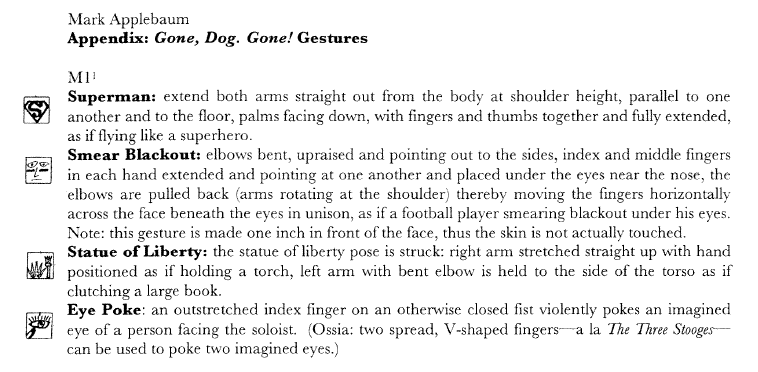
Applebaum's piece consists of two kinds of music: The sound created by eight instruments—conventional, invented, or found—and silent hand gestures. Over 80 gestures are indicated, ranging from "Thumbs Up" to "Etch A Sketch" to "Bubble Wrap". Each gesture has a symbol and detailed instructions, all of which have to be memorized and performed rapidly, with precision:
The score also referencecs source materials—28 grooves found in pop or rock pieces—which provide both rhythm and tempo. For example, the first page alone includes references to The Beatles, The Kinks, AC/DC, Led Zeppelin, Wild Cherry, and Aerosmith:
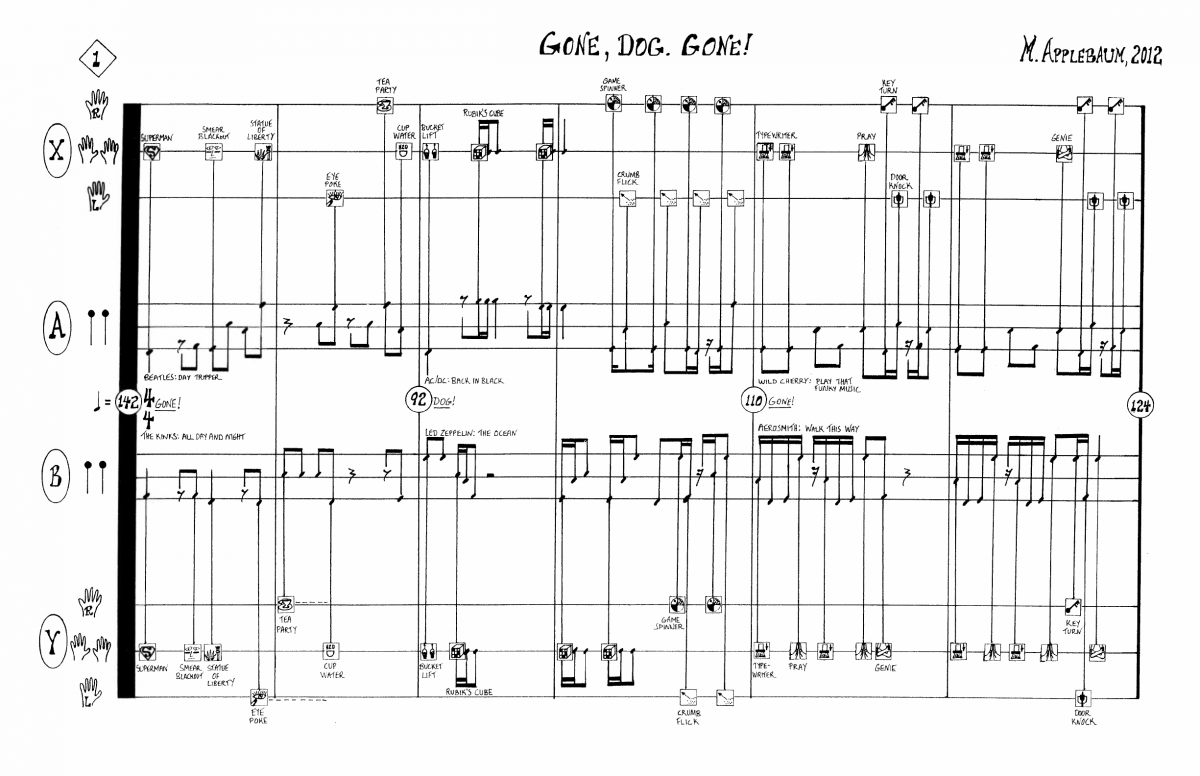
Gone, Dog. Gone! is a companion piece to Applebaum's Aphasia, a work explored by many Yellow Barn perussionists, including the four percussionists in this year's Young Artists Program. Just a few weeks ago Nupur Thakkar recorded the following performance: