
CONTENTS
I. News from the Yellow Barn Garden
II. Reading From Across the Room: From the Stage to the Back Row with Bill Kelly
III. Watch performances from last summer in the Big Barn
DATES OF NOTE
Fall Artist Residencies
Thursday, November 13 at 7:30pm in the Big Barn: Sarah Rommel, cello
Friday, December 12 at 7:30pm in Sun Hill Studio: Seth Knopp, piano; Katherine Yoon, violin; Gerard Flotats, cello
Friday, December 19 at 7:30pm in the Big Barn: Ize Trio (Chase Morrin, piano; George Lernis, percussion; Naseem Alatrash, cello)
View the complete schedule of 2025-26 Artist Residencies
2026 Summer Season
Yellow Barn Festival Concerts: July 10-August 8, 2026
Helena Tulve, Composer in Residence: August 3-8, 2026
Young Artists Program Concerts: June 21-July 3, 2026
News from the YELLOW BARN GARDEN
It has been nearly a year since the first open meeting for the Putney community about our plans for a garden surrounding the Big Barn. Present that evening was garden designer and longtime Putney resident Gordon Hayward. Gordon, who has been a friend of Yellow Barn since its earliest years, generously embraced the process of bringing together our evolving ideas for Yellow Barn "inside out", the initial plan that we created together with landscape architect Chris Donohue at Michael Van Valkenburgh Associates, and the ideas and needs expressed by the Putney community at our meetings and in the Town Plan.
Gordon directed the initial uncovering of the land and its trees with arborist Bob Everingham (often introduced by Gordon as a "poet with a chain saw"). The site of the historic Putney Nursery, which was started by George Aiken about 100 years ago, our garden's stature came to light—a sentinel wolf pine in the south field, a grove of poplars near the Putney Co-op, a row of pin oaks near the back entrance, and a circle of evergreens and pachysandra near the library. We set to work clearing the property of invasive species, opening views to the Putney Co-op and Main Street, and keeping the property mowed to promote safe and enjoyable walking.
Immediately, we noticed a difference! People began incorporating our garden into their daily patterns of walking and resting, audience members approached our concerts from new directions, and arrived with open curiosity. "I have lived in Putney for 30 years... How have I never been to Yellow Barn?" was a frequent exclamation, and our hall was full every night of the season.
Just before the start of the festival, Gordon presented us with a design that shows how every need could be met on just 3.7 acres of land. It is an extraordinary gift! To see ideas come to life, made beautiful by Gordon's experience and imagination, is both humbling and energizing. His design will now inform our interpretation of Chris Donohue's plan as we strive to create a space that resonates with all of us.
The clearing of the Big Barn property, and this synthesis of ideas, marks the end of Phase I of our garden creation. Between now and the start of the annual audition tour in early January, we will finalize our strategy for building and planting. 14 individuals and families made it possible for us to purchase the Big Barn and to see all that its surrounding property has to offer. In Phase II, everyone will have the opportunity to give the gift of a Yellow Barn Garden to each other.
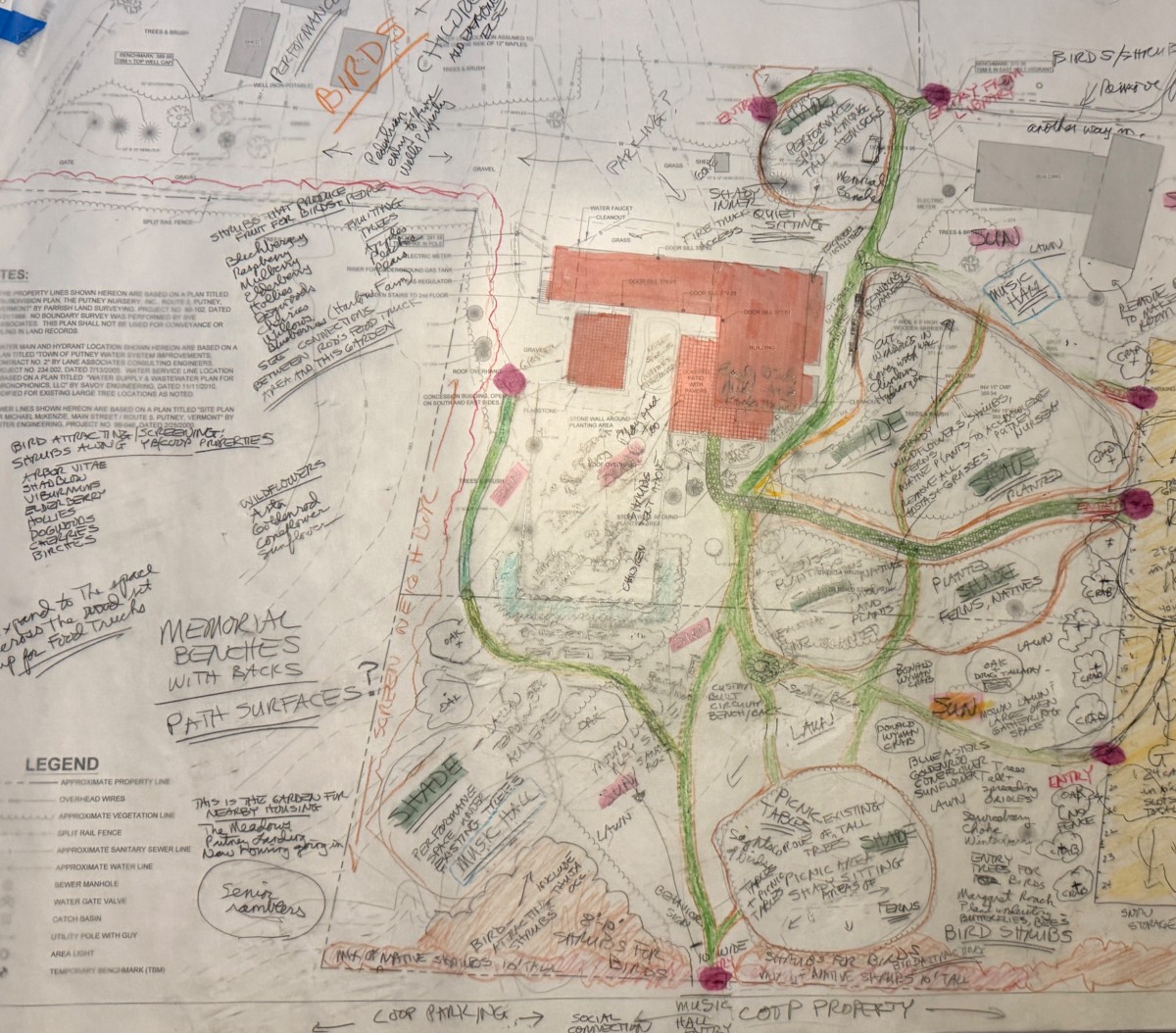
Gordon Hayward's drawing for the Big Barn property
READING FROM ACROSS THE ROOM:
From the Stage to the Back Row with Bill Kelly
Bill Kelly is a painter, printmaker, and sculptor. He founded Brighton Press, a fine press artists’ book publisher in 1980. Since 1997, he has created hundreds of “Wall Programs” and other art as Yellow Barn’s Artist-in-Residence, and you can find him sitting in the back row of almost every Yellow Barn concert.
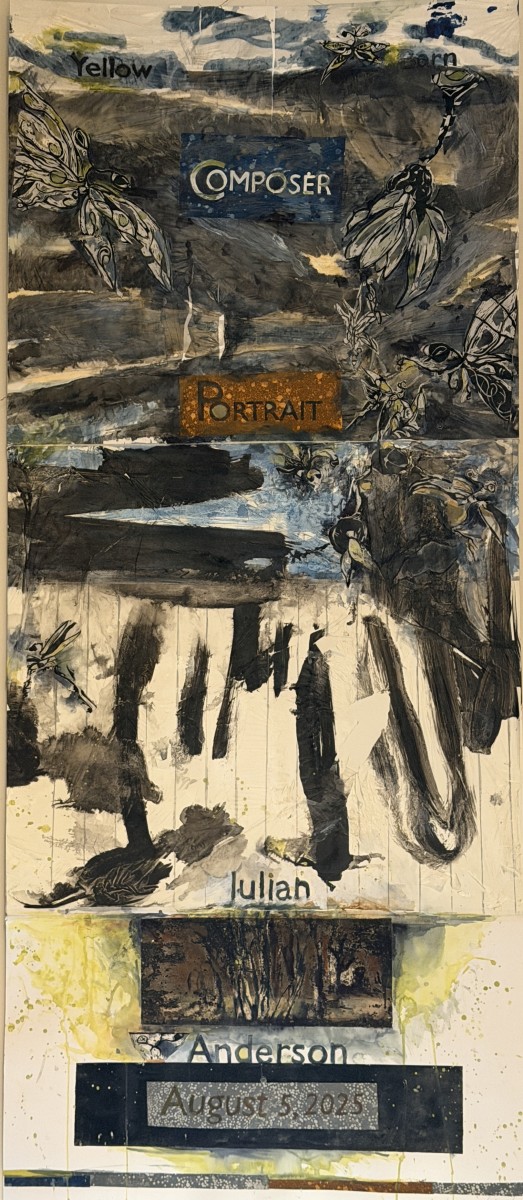
Bill Kelly's wall program from this year's Composer Portrait
"Making a Wall Program"
(Bill Kelly’s advice and ideas sent to all Yellow Barn musicians before they arrive each summer.)
Advice
It is helpful if your poster can be read from across the room.
Keep sight of things that are important in your design. Remember the unifying reason for the poster.
White-out is not a solution to a mistake like it is in typing, hence the visible traces of all of the moves an artist has made and will make.
Most art falls in a range between light and dark. There is no such a thing as black and white in art.
Do not leave dirty brushes in the sink. They are like your instruments; don’t leave them out in the rain or unattended. Make sure to use the right brush for the right job.
Ideas
-Move like a dancer, think like a poet/philosopher.
-Push, but don’t reach. I don’t know how to do this, but I keep trying.
-Don’t aim to please.
-Paint like you mean it.
-Don’t spell Haydn “Hayden” as I did once. It ruined my evening and still haunts me.
-You are part of something big, and a poster is a visual artifact of the moment. Nothing more, nothing less.
In June of 1997, just a few days after my first Yellow Barn summer had begun, I wandered over to the art studio where Bill Kelly taught painting and drawing at the Putney School. Hanging concert programs on the wall above the Yellow Barn stage was a tradition I had inherited, and it made me curious. On concert evenings simple programs were handed out, but I liked the idea that from the audience one could also choose to look through, or next to, the players to get this most basic information.
In my memory, our first meeting was as it has always been since, an easy friendship grounded in art and music. I asked Bill if his class might be interested in sitting in on Yellow Barn rehearsals and then adding “image” to our Wall Program tradition. Bill did not ask anything other than, “When do you want us there?”
These many years later, Bill’s work has become a visual metaphor of what Yellow Barn strives to be, an essential presence when we dream Yellow Barn.
—Seth Knopp
Almost nightly, as a participant at Yellow Barn concerts (by that I mean a participating member of the audience), I wonder at this complicated relationship, between being merely entertained and understanding the complex dynamic that our senses experience. In any given moment, the story that music gives us is in a sense staged, not just performed. Notes may appear static on the score, but sound is an ever-evolving story.
What I see not, I better see—
On any given night we feel familiarity and spontaneity, discord and harmony, surrendering to both sheer beauty and the mystery of the composer’s search. We hear whatever form this arrangement of invention and movement may take through the musician’s voice, and on many evenings, Seth gives us written clues, inspirations in their own original “other” form that often appear along with titles and texts. But the intimacy of scale at Yellow Barn allows us to easily connect with anybody we feel moved to approach, and I take advantage of this by taking it a step further. A conversation with a musician I have only moments ago admired from the audience is spontaneously recorded in my sketchbook:
Pianist Gil Kalish speaking of George Crumb: “George creates atmospheres of wonder. His music deals with the most important aspects of our human experience. Life, death, love and the spirit behind all of that, whether it be GOD or something more ephemeral . . . I deeply believe that his music will be heard and played for as long as there is a human spirit.”
Percussionist Eduardo Leandro takes my sketchbook and furiously writes: “There’s a character in a Milan Kundera novel that is based in gesture. Can’t remember the book’s name. Percussion is the one instrument that cannot be defined by an object, but more by a gesture. Not only hitting an object, but sometimes caressing it or being it, making my own body the object.”
The scope of what one takes in at Yellow Barn over the course of a season is resonant and powerful because of all the possibilities one is given to experience in imagery and imagination. As a visual artist I was moved to questions and inspired to create all this in my own way. Part of a grateful and thoughtful audience, I glimpse the meaning of Emily Dickinson’s poem. I cannot ask to see more than that.
What I see not, I better see—
Through Faith—my Hazel Eye
Has periods of shutting—
But, No lid has Memory—
For frequent, all my sense obscured
I equally behold
As someone held a light unto
The Features so beloved—
And I arise—and in my Dream—
Do Thee distinguished Grace—
Till jealous Daylight interrupt—
And mar thy perfectness—
—Bill Kelly
Watch performances from the Big Barn
Visit Yellow Barn's YouTube Channel to watch performances from the Big Barn, including over 50 from last summer!
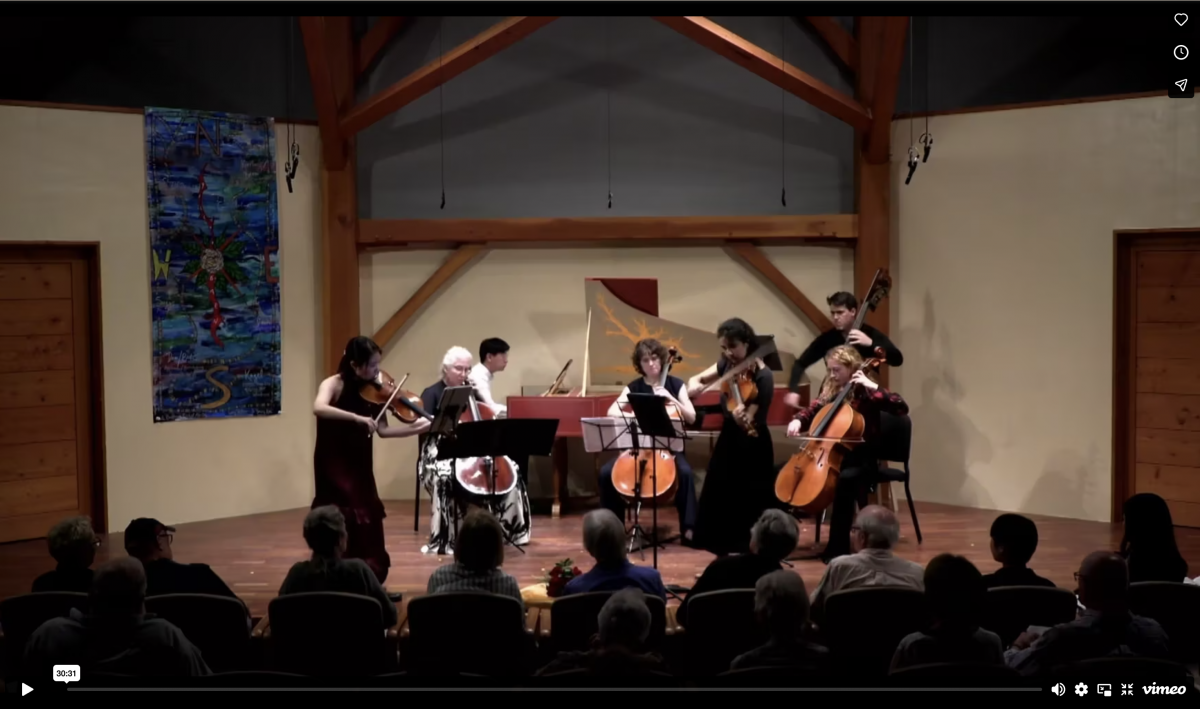
Dean Approach (Prelude to a Canon) (2017)
Johann Sebastian Bach (1685-1750) Brandenburg Concerto No. 6 in B-flat Major,
BWV1051 (1718)
Yeh-Chun Lin, Cara Pogossian, violas; Julia Lichten, Florianne Remme,
Madelyn Kowalski, cellos; Sam Suggs, double bass; Ryan Jung, harpsichord
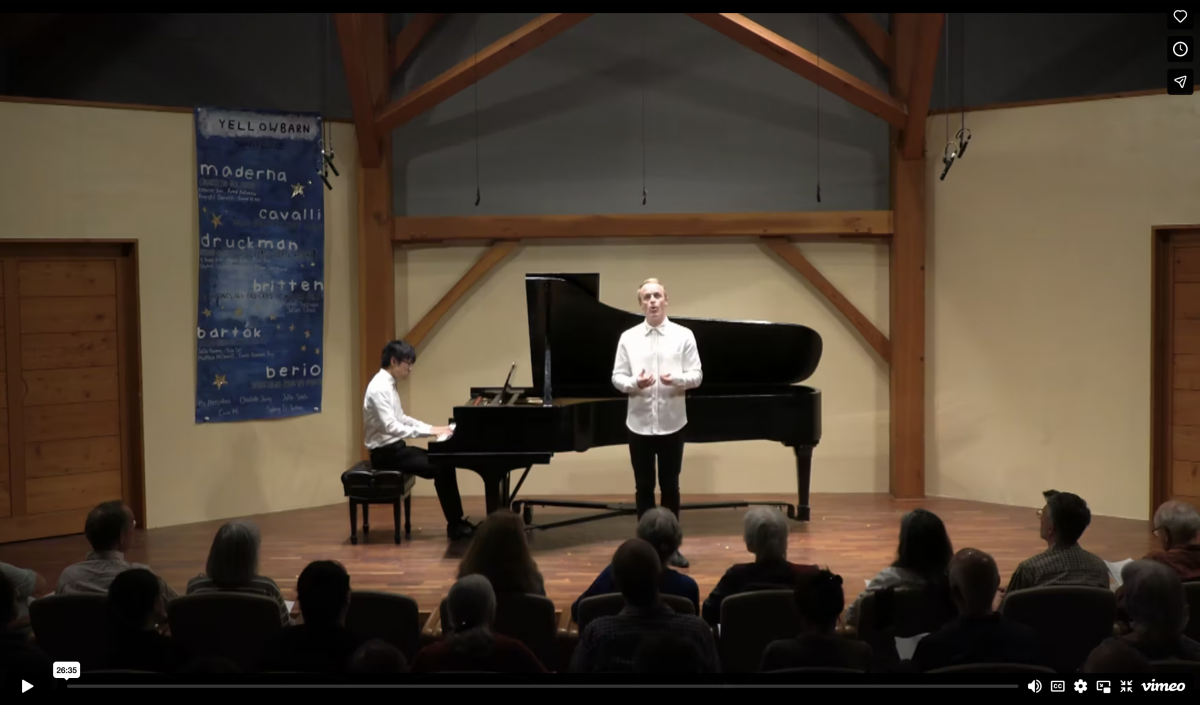
Benjamin Britten (1913-1976) Songs and Proverbs of William Blake, Op.74 (1965)
Nathaniel Sullivan, baritone; Julian Chan, piano
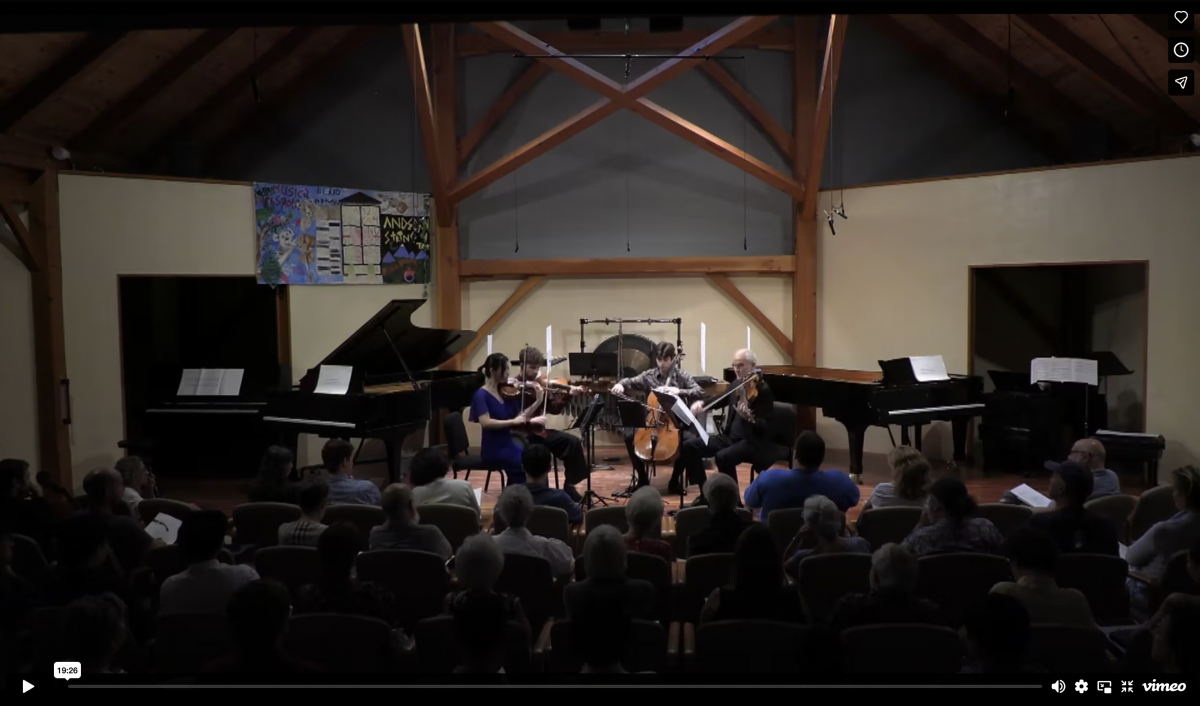
Julian Anderson (b.1967) String Quartet No. 4 (2023)
Yeim Lee, Ele Bienzobas, violins; Jonathan Brown, viola; Gerard Flotats, cello